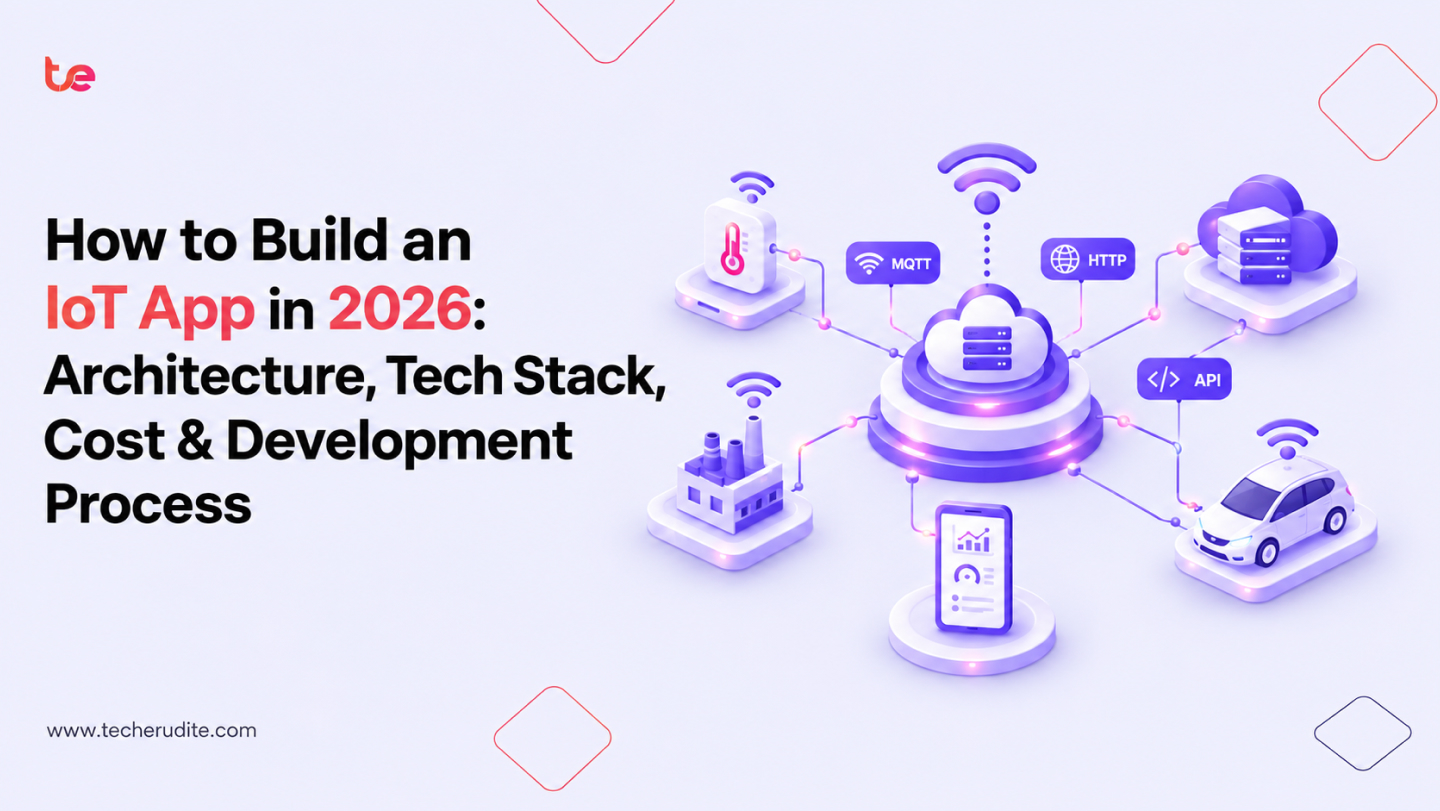
IoT app development is the process of building applications that connect with IoT devices, collect and process device data, and let users monitor, control, or automate connected systems. The demand for these applications continues to grow as businesses connect more equipment, assets, and processes.
In fact, 66% of organizations surveyed in Verizon’s 2025 IoT Market Insights Report already had a cellular IoT deployment in place and operational.
By 2026, IoT application development is not only about developing the mobile interface of the application but also about coordinating between connected devices, communication channels, back-end systems or clouds, APIs, and the application itself.
In this guide to IoT app development, we’ll cover IoT architecture and more.
What Is IoT App Development?
The process of IoT application development includes creation of software that provides connectivity between users and internet-enabled devices for data collection, monitoring of activities, and control over interconnected systems. The IoT app development solutions may include smart home solutions, healthcare monitoring, industrial monitoring, vehicle tracking, smart agriculture, and energy management.
An IoT device is physical hardware, such as a sensor, that collects or sends data. The IoT application refers to the mobile/web application used by the user for interaction purposes. The IoT Platform provides solutions for connecting, managing, and monitoring the devices, whereas the IoT Backend deals with data processing and other related services.
For example, in a typical IoT implementation, the mobile application can show live sensor readings as the backend handles device communication and authentication and data processing. These connected components form the foundation of modern Internet of Things app development.
How Does an IoT App Work?
The IoT mobile application connects to the IoT device via different protocols such as MQTT, HTTP, and HTTPS/web sockets. As the IoT device sends data to the gateway or cloud backend, the mobile application will give commands to the IoT device via the connected network.
The process generally follows five steps as follows.
- Sensors and devices collect data: Sensors record data like temperature, position, motion, or status of the device.
- Connectivity transfers data: Data is sent through Wi-Fi, Bluetooth, 3G/4G/5G, or LoRaWAN.
- Gateway or edge layer processes data: Processing can be done locally, and filtering information will save processing time before uploading it on the cloud.
- Backend/cloud processes information: The backend stores, analyzes, and manages device data.
- Mobile or web app displays data: Users can view information, receive alerts, or send commands for configuration and automation.
IoT App Architecture: Key Components
An ideal IoT architecture links devices, networks, backend systems, and applications in an organized process flow. Every layer is assigned to collect, transport, process, and present information.
1. IoT Devices & Sensors
This layer consists of devices that collect data, devices that initiate actions, devices that control the operation of other devices, and software that controls the functioning of devices.
2. Connectivity Layer
Communication can be done through different technologies such as Wi-Fi, Bluetooth/Low Energy, 5G, cellular or LoRa WAN. The selection will depend on distance, bandwidth, power consumption, and application.
3. Gateway / Edge Layer
Gateways have the ability to screen data, change communication protocols, and even process data locally prior to sending data to the cloud. This can reduce latency and network traffic.
4. IoT Backend / Cloud
Backend controls APIs, devices, databases, authentication, data processing, and cloud services. It is a system that connects the devices with the applications.
5. Application Layer
This includes mobile applications, web dashboards, admin panels, and analytical tools that are used to track data and manage devices that are connected.
6. Security Layer
Security is available at all levels via encryption, authentication, authorization, secure APIs, and management of device identity. Layered security is key for the scalability of IoT application development.
An experienced IoT mobile app development company should consider security from the architecture stage.
Best Tech Stack for IoT App Development in 2026
The choice of technology stack will be based on the following considerations: the device types, network conditions, type of application, scalability, and volume of data. An example of a technology stack suitable for IoT app development services is as follows.
| Layer | Technologies to Consider |
| Mobile | Flutter, React Native, Kotlin, Swift |
| Frontend | React, Vue.js |
| Backend | Node.js, Python, Java |
| Communication | MQTT, HTTP/HTTPS, WebSockets |
| Cloud | AWS, Azure, Google Cloud |
| Database | PostgreSQL, MongoDB, TimescaleDB |
| IoT Platform | AWS IoT, Azure IoT |
| Analytics | Python, cloud analytics tools |
| Security | TLS, OAuth 2.0, JWT |
The reason MQTT is suitable for light-weight communication between devices is due to its development in light-bandwidth environments. WebSocket is ideal for applications where a real-time connection is needed. Flutter and React Native are ideal for cross-platform applications but not for native Android and iOS applications.
The backend could be developed using Node.js, Python, or Java. Scalable infrastructure could be achieved through services like AWS, Azure, or Google Cloud. This could assist in scalable IoT app development solutions.
How to Develop an IoT App: Step-by-Step Process
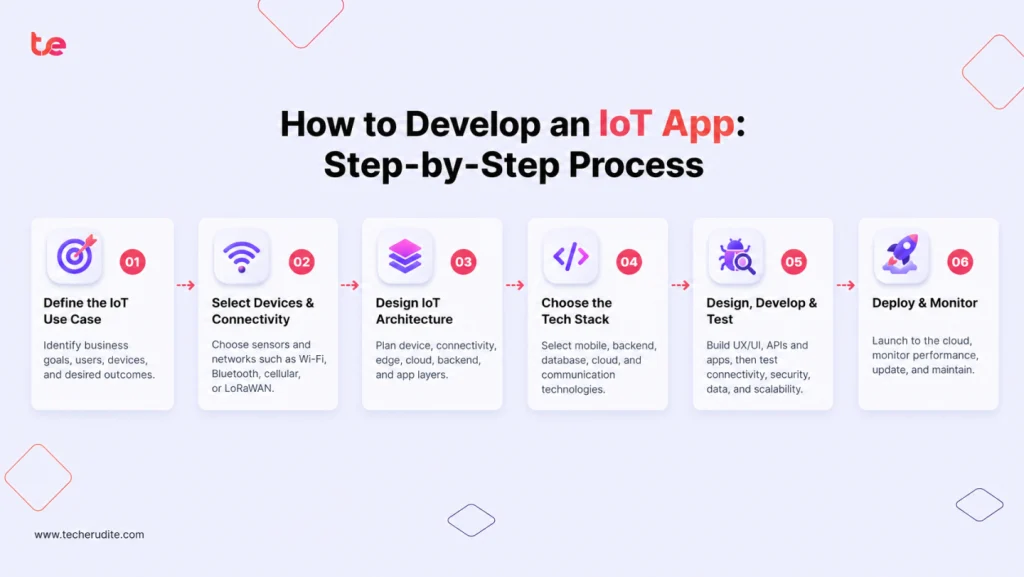
Step 1 – Define the IoT Use Case
The first step is to recognize the business problem, target users, related devices, and desired results. This will be useful for understanding which features, architecture, and technologies are required.
Step 2 – Select IoT Devices & Connectivity
Choose sensors and devices based on requirements of data, connection, power, and environment. Wi-Fi, Bluetooth, cellular, and LoRaWAN may be suitable for different purposes.
Step 3 – Design IoT Architecture
Plan how the device layer, communication protocols, edge layer, cloud infrastructure, and application will work together. The architecture should support reliable data flow and future scalability.
Step 4 – Choose the Technology Stack
Select the technologies for mobiles, backend, databases, cloud, and communication that suit your requirements. The technologies used include MQTT, Node.js, Python, Flutter, and Cloud.
Step 5 – Design the UX/UI
Create simple dashboards with real-time data, alerts, device controls, and accessible navigation. The interface should make complex device information easy to understand.
Step 6 – Develop Backend & APIs
Build the backend for device communication, authentication, data processing, APIs, and database management. It should securely handle growing volumes of device data.
Step 7 – Develop Mobile/Web Application
Create apps for Android, iOS, or both with native or cross-platform development. Web dashboard can offer more monitoring and management capabilities.
Step 8 – Test the IoT Ecosystem
Test for device connectivity, API performance, security, live data, scalability, and offline cases under varying conditions.
Step 9 – Deploy & Monitor
Launch the solution in the cloud, track its performance, issue upgrades, and conduct maintenance.
Want an IoT application that scales well to suit your enterprise? Consult our IoT application development experts about your use case and how you can get started.
How Much Does IoT App Development Cost in 2026?
The cost of developing an IoT application in 2026 depends on many factors, such as the scope of the work, the range of the devices involved, features to be implemented, and technical specifications. Such considerations as the variety of the devices, their complexity, the mobile platform to use, backend architecture, real-time communication, etc.
| Project Complexity | Typical Scope |
| Basic | Device monitoring + simple mobile app |
| Medium | Multiple devices + cloud + dashboard + alerts |
| Advanced | Large-scale devices + real-time processing + analytics + complex integrations |
The basic IoT app might need less number of integrations and easy backend systems, whereas the complex one might use thousands of devices along with real-time data analytics, APIs, higher levels of security, and cloud infrastructure, among others. Hiring professional IoT app development services can reduce technical risks and changes in the future.
An IoT app development company will consider all these factors to provide you with an accurate estimate. They will also look ahead to how your solution will scale in the future, and not just what is required at the outset.
Key Features of a Modern IoT Application
- Real-time device monitoring: Monitor the status and sensor data of your devices in real time.
- Remote device control: Control your devices remotely.
- Push notifications: Get important notifications.
- Data visualization: Visualize complicated IoT data using graphs.
- Automated alerts: Get an alert for the pre-set situations.
- Device management: Devices can be added, configured, updated, and removed.
- User authentication: User and device protection.
- Asset tracking: Track the location of assets.
- Analytics and reporting: Analyze trends and prepare meaningful reports.
- Proactive maintenance: Detect any issues with the equipment.
- Multiple device management: Manage multiple devices from a single application.
- Role-based access control: Features that depend on user roles.
These features are important considerations in modern IoT application development.
IoT App Development Challenges & Security Considerations
Common challenges include compatibility, scalability, poor network performance, real-time data processing capabilities, limited battery power, difficult integration processes, and device management. Security must be integrated into the development process to secure the devices, the user, and the data.
Key Challenges and Security Measures
IoT applications should support different devices and remain reliable as connected devices increase. Developers must also ensure the efficient use of battery, integration, and real-time data.
Security must be ensured through device authentication, encryption, secure APIs, access controls, updating firmware, data privacy, and network security. This will go a long way in ensuring that any form of unauthorized access is reduced to the minimum.
How to Choose an IoT App Development Company
Before hiring an IoT app development company, consider the following factors.
- IoT Experience: Verify experience with connected devices and IoT projects.
- Industry experience: Verify that the team has experience with your specific industry.
- Mobile + backend: Verify the ability to develop both mobile apps and backend systems.
- Cloud expertise: Verify experience with cloud and IoT platforms.
- Security Practices: Check on your authentication, encryption, and secure API practices.
- Scalability: Select an IoT application development company that can handle increasing devices and users.
- Post-Launch Support: Ensure continued maintenance, monitoring, updating, and technical support.
Wrapping It Up
Building a successful IoT application requires more than connecting devices. It involves a well-planned combination of connected devices, communication protocols, backend infrastructure, cloud services, security, and user-facing applications. Before development begins, businesses should clearly define their use case, device ecosystem, scalability requirements, and technology needs. With the right architecture and development approach, Techerudite helps businesses build scalable and secure IoT applications tailored to their specific operational and business requirements.