
“IoT devices can collect information, yet without intelligence, just information cannot make smarter business decisions.”
Modern-day organizations are constantly generating real-time data using connected devices. Still, conventional IoT platforms usually fail to provide enough intelligence for efficient decision-making and predicting outcomes.
In 2026, there will be a greater need for smart IoT-based systems combining automation and analytics features to produce relevant real-time insights. Increasing demand is leading to the fast adoption of IoT app development companies that rely on Artificial Intelligence along with IoT to generate intelligent and future-proof applications.
AIoT Explained in Simple Terms
The term “AIoT” means Artificial Intelligence plus Internet of Things. The concept of AIoT means the application of intelligent devices that can collect data, recognize trends, make predictions, and perform automation without continuous human intervention.
For IoT ecosystems, the connected devices only collect and transmit data. With the addition of AI technology within the IoT ecosystem, business organizations become more capable of making quick and intelligent decisions. It is one of the key factors driving the growing demand for AIoT application development services by businesses.
Featured Snippet Definition
AIoT refers to the combination of AI and IoT technology, where data is gathered from devices, analyzed using intelligent systems, and decisions are made and actions taken.
AIoT helps businesses become more efficient in their operations, reduce human efforts, and become smarter.
Why Businesses Are Rapidly Adopting AIoT Solutions
There are many reasons why firms are adopting AIoT faster, but some of them are the ability to improve automation, increase speed, and improve decision-making. The traditional system involves monitoring manually and taking long to respond.
The rising demand for automation is one of the primary factors that has led to the emergence of IoT app development services. This is because companies require systems capable of reducing manual work. AIoT makes it possible to process live data, anticipate issues, and automate actions. The global IoT market is expected to reach $1.8 trillion by 2026, highlighting the increasing reliance on connected technologies across industries.
- In manufacturing industries, intelligent machines can sense faults in machinery even before any malfunction takes place.
- In health care institutions, smart devices assist medical practitioners in monitoring patients remotely and getting immediate notifications in case something happens.
- Intelligent systems have been implemented in retail stores to manage inventories and analyze customers’ purchasing patterns.
Another factor that can provide businesses with a competitive edge is that AIoT helps enhance productivity and improve customer experience while cutting down on costs. A recent study shows that AI adoption in businesses has grown by 270% in recent years.
Difference Between AIoT and Traditional IoT
The Traditional IoT systems have connectivity and data gathering as the major considerations. Yet, in AIoT, intelligence, prediction, and automation take center stage within the interconnected ecosystem. Organizations are gradually leaning towards artificial intelligence for its efficiency and scalability, among other qualities.
| Feature | Traditional IoT | AIoT |
| Data Processing | Reactive | Intelligent |
| Decision Making | Manual | Automated |
| Analytics | Basic | Predictive |
| Automation | Limited | Advanced |
| User Experience | Static | Personalized |
Whereas traditional IoT devices collect and analyze data manually, AIoT devices automatically analyze collected data and perform intelligent actions. As a result, AIoT technology provides enterprises with increased efficiency and scalability.
Firms that invest in IoT application development combined with AI technologies have the advantage of having intelligent automation, predictive maintenance, and enhanced analytics that can increase operational efficiency substantially.
How AI + IoT Work Together
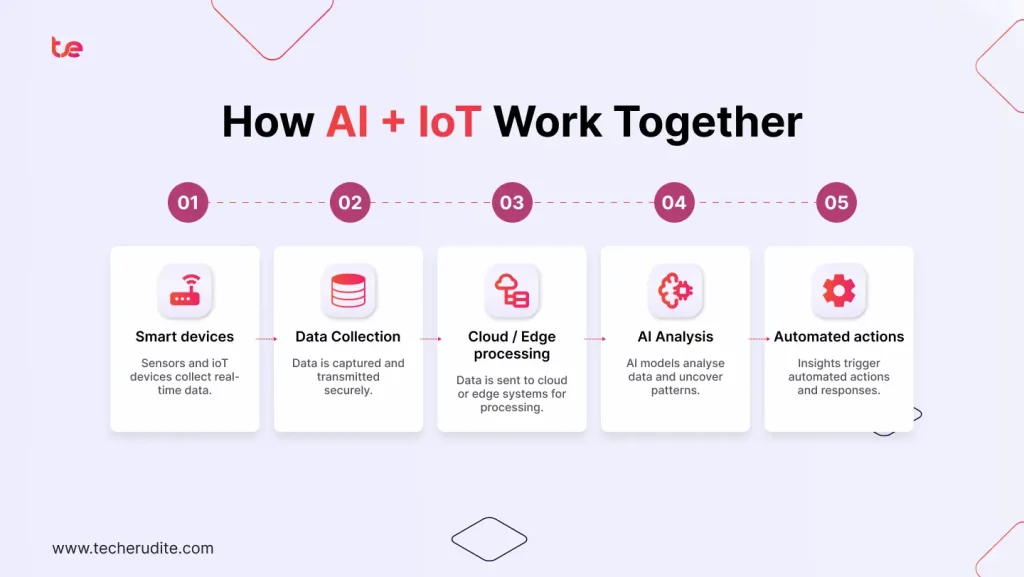
Combining artificial intelligence and IoT results in intelligent ecosystems that have the capability for real-time automation and decision making. Organizations that implement IoT web application development using artificial intelligence can create intelligent systems that continuously learn and improve over time.
The process of implementing AIoT usually involves the following key steps.
Step 1: Smart Devices Collect Data
IoT devices and sensors collect information including temperature, movement, location, pressure, energy consumption, or customer behavior. The IoT devices create massive amounts of data constantly.
Step 2: Data Is Sent to Cloud or Edge Systems
Collected information is sent to the cloud infrastructure or edge computing system for data processing. The cloud system helps in handling scalability issues, while edge systems minimize latency.
Step 3: AI Algorithms Analyze Data
The machine learning algorithm studies the collected data to recognize patterns and derive predictive results. The accuracy of AI systems improves continually due to the process of constant learning.
Step 4: System Predicts Outcomes
The AI algorithms predict future events like machinery breakdowns, inventory stockouts, or consumer behavior patterns using data from the past and present.
Step 5: Automated Actions Occur
Intelligent actions like maintenance notification, security response, route optimization, or energy management can be performed automatically by the system.
The intelligent workflow highlights the increasing need for AIoT app development services for businesses looking to automate their operations and get real-time operational intelligence.
AIoT Architecture Explained
AIoT architectures consist of different layers that function together to gather, process, analyze and perform automation activities based on data.
Firms that invest in scalable IoT app development services also prefer cloud-native AIoT frameworks since these increase the level of flexibility, security, and efficiency.
Technologies Powering AIoT Applications
A combination of multiple high-tech methods is used to facilitate AI-enabled Internet of Things platforms. Companies that partner with a reputable IoT app development company frequently use these technologies when designing their smart apps.
Artificial Intelligence
AI helps computers to analyze data, make decisions, and automate processes effectively.
Machine Learning
Through machine learning, computer algorithms enhance their ability to make accurate predictions based on past and present datasets.
Edge Computing
Edge computing involves the processing of data locally in order to allow real-time automation processes to be executed effectively.
Cloud Computing
Cloud computing refers to the infrastructure that offers the ability to store and process data.
Big Data Analytics
Big data analytics helps organizations to understand operational and consumer behaviors through analysis of big data.
5G Connectivity
The 5G connectivity provides faster and more reliable communication between the interconnected IoT devices.
Computer Vision
The computer vision technology allows recognizing images by using artificial intelligence technology and is widely applied in healthcare, manufacturing, and surveillance systems.
Natural Language Processing (NLP)
The NLP technology makes it possible for AI systems to process human language.
Together, these technologies help fuel the growth of AIoT solutions in industries.
Key Benefits of AIoT Applications
Among the major benefits of AIoT in smart application development is real-time decision-making capability. Companies can perform an analysis of operational data and make decisions in real time without the need for much human effort.
Another major benefit offered by the use of AI in industry is predictive maintenance, as AI-powered systems have the capability to identify equipment problems before a malfunction takes place.
AIoT can also help improve customer experience by providing personalized services. The algorithm uses user behavior to generate personalized recommendations and interactions.
Other advantages include the following.
- Improved operational efficiency
- Decreased operational cost
- Quick business decision-making
- Efficient energy optimization
- Increased cybersecurity
- Workflow automation
As per industrial technology analysts, organizations which employ AI-enabled approaches for the development of smart IoT applications enjoy scalability and efficiency advantages over their counterparts using only IoT-based solutions.
Need to develop intelligent AIoT solutions for your business?
Top AIoT Use Cases in 2026
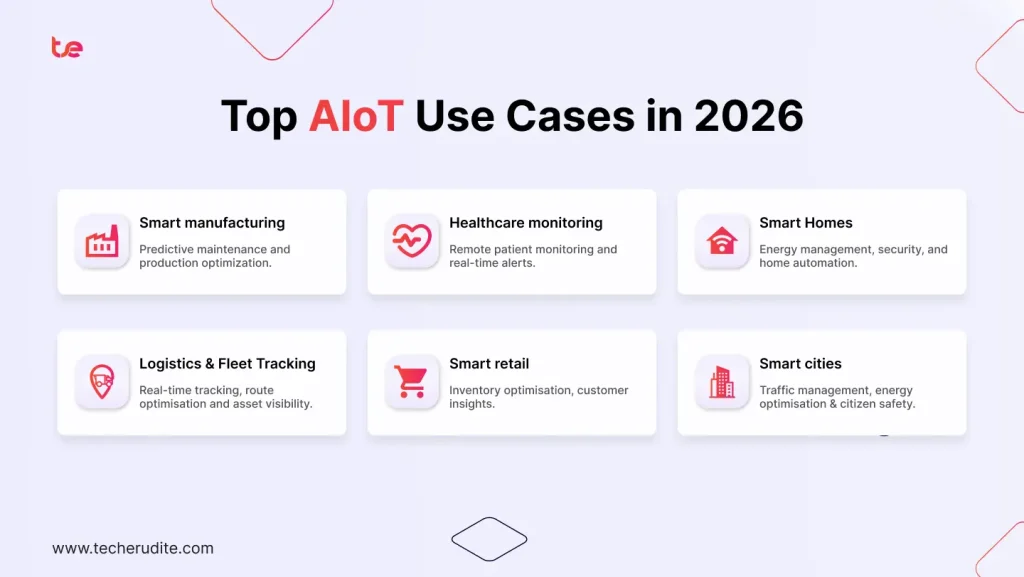
AIoT is revolutionizing many different industries through intelligent automation, predictive analytics, and monitoring operations in real-time. Firms in all different sectors are looking more and more towards AIoT app development services for businesses.
Healthcare
The healthcare sector is adopting AIoT technologies in applications such as remote patient surveillance, wearables, and AI-based diagnosis. Smart health facilities can monitor patient states constantly, predicting medical dangers even before an emergency occurs.
Smart Homes
Smart homes using AIoT provide increased convenience, energy efficiency, and security with intelligent automation systems. Intelligent voice assistants, smart surveillance systems, and energy management systems make living more personal.
Manufacturing & IIoT
AIoT industrial systems provide functions such as predictive maintenance, machine monitoring, and intelligent factory automation. These companies deploy AI-based analytical techniques to improve production workflow efficiencies.
Case Study
In one year after implementing predictive maintenance using AIoT solutions for real-time business automation, a manufacturing enterprise experienced a 40 percent reduction in downtime for their equipment.
Retail
Retail businesses make use of AIoT for customer analytics, automated checkouts, and intelligent inventory management. AI-enabled solutions allow retailers to boost customer engagement while minimizing inefficiencies.
Logistics & Transportation
These AIoT technologies help improve fleet tracking, optimize routes, reduce fuel consumption, and increase autonomy of the transport system. Logistics companies gain advantages such as operational visibility and predictive route management.
Why Edge AI Is Critical for Modern AIoT Apps
Edge AI is now considered necessary in modern AIoT architectures because companies need higher speeds and shorter latencies. Rather than transmitting data to the cloud for processing, edge computing processes data closer to the connected devices.
The architecture enhances performance efficiency by minimizing reliance on cloud computing while saving on bandwidth costs. Companies engaging in IoT web application development have begun to incorporate edge intelligence for real-time automation.
Edge AI is very important to self-driving cars, robots in industry, and smart manufacturing systems because delays, even small ones, can affect the performance of these machines.
With AI and edge computing integration, organizations can develop intelligent systems that can make real-time decisions without having to rely on centralized cloud computing.
Major Challenges Businesses Face with AIoT
Even when AIoT is quite beneficial, there are many technical and practical problems that businesses need to tackle when adopting it. Any company willing to invest in AIoT app development services for business will need to deal with a number of issues.
Data privacy is one of the major issues as data collection from connected systems takes place on a constant basis in huge volumes. Enterprises need to ensure that strong encryption and secure APIs are in place.
Another important challenge for us is cybersecurity because IoT-connected devices may become potential targets for attacks if they are not secure.
Additional challenges include the following.
- Device compatibility issues
- Infrastructure costs
- Complex integrations
- Large-scale data management
- Scalability limitations
Experienced IoT app development company teams often use cloud-native infrastructure, automated monitoring tools, and advanced security frameworks to overcome these challenges effectively.
AIoT Development Cost Breakdown
The cost to develop intelligent AIoT applications is dictated by many aspects. Firms interested in Mobile app development and AI-based automation software should consider their future needs when budgeting for a project.
| Project Type | Estimated Cost |
| Basic AIoT MVP | $10,000–$25,000 |
| Mid-Level Solution | $25,000–$80,000 |
| Enterprise AIoT Platform | $100,000+ |
Some of the considerations for setting development prices include the following.
- Number of connected devices
- Complexity of AI models
- Necessity for real-time analysis
- Cloud-based services
- Security measures
- Compatibility
Companies that partner with a reputed IoT app development company generally end up cutting down on future expenses on infrastructure and maintenance.
How to Build an AIoT Application
For building an efficient AIoT system, planning, scalable architecture, and AI capabilities will be essential. When companies engage in IoT app development services, it is important for them to go through a proper development process.
AIoT development usually involves the following steps.
- Requirement analysis
- Device and sensor selection
- Architecture design
- Cloud platform integration
- Training of AI model
- Mobile application development
- Security measures
- Testing and launch
- Maintenance and updates
Professional AI development services will help companies to construct scalable AI-powered environments suitable for automation and optimization.
Technologies Used in AIoT App Development
The design and IoT application development require several types of frameworks, platforms, and communications technology.
| Category | Technologies |
| Frontend | Flutter, React Native |
| Backend | Node.js, Python |
| AI Frameworks | TensorFlow, PyTorch |
| Cloud Platforms | AWS IoT, Azure IoT, Google Cloud IoT |
| Communication Protocols | MQTT, CoAP, HTTP |
These technologies provide scalable automation, artificial intelligence processing, and real-time connectivity within AIoT environments.
Emerging AIoT Trends Businesses Should Watch
The future of AIoT is changing very fast as companies keep investing in automation and intelligent digital transformation strategy. Companies implementing new AIoT solutions now will have an advantage in the future.
Another big trend is the use of Generative AI in IoT. Companies are making use of insights generated from AI for automation and customer interaction, among other things.
Other emerging trends include the following.
- Digital twins
- Hyperautomation
- Autonomous systems
- Smart cities
- Robots empowered by AI
- Edge computing
These examples show how AI and IoT are transforming app development and business operations around the world.
Business Impact of AIoT Solutions
Companies using intelligent AIoT ecosystems are seeing tangible gains in their operations and ROI benefits. Businesses adopting scalable IoT web application development techniques are enjoying quick operation times, better experiences for customers, and more automation.
AIoT improves business efficiency through the minimization of manual efforts, gaining insights, and predictive decision making. This allows organizations to respond to market changes quickly.
Some long-term benefits that businesses can enjoy from their implementation include the following.
- Improved efficiency
- More efficient decision making
- Income generation opportunities
- Better scalability
- Customer engagement
- Less downtime
Businesses implementing AIoT for real-time business automation have realized many benefits.
Key Takeaways from AIoT in 2026
AIoT technology will change the face of the future when it comes to intelligent applications. Companies that utilize IoT app development services along with the use of AI technology will get access to intelligence and automation services.
Organizations which are using AI development services and intelligent automation solutions are gaining efficiency, cutting down costs, and ensuring great customer experiences.
Since the evolution of AI and IoT is continuous, organizations that adopt scalable AIoT solutions will have competitive advantages in the future.
Final Thoughts on the Future of AIoT
AIoT is revolutionizing the future of smart applications with the ability to automate business processes and make decisions, and to make customer experiences smarter with real-time intelligence.
Firms adopting scalable AIoT app development services for businesses are enjoying huge benefits through automation and digital transformation of their business processes.
With the continued evolution of connected ecosystems, businesses that adopt smart IoT application development solutions driven by AI will always stay ahead of the game.
Looking to develop secure and scalable AIoT solutions tailored to your business goals?