
Selecting the correct backend technology stack can be considered the most important decision while developing a web app. It influences the development time, application performance, security aspects, scalability in the future, and general maintenance. That is why the comparison of Laravel vs Node.js is still relevant in 2026.
According to W3Techs, PHP powers more than 70.5% of all websites whose server-side programming language is known, while Node.js continues to be a leading runtime for real-time and high-performance applications.
In this article, Laravel vs Node.js will be analyzed taking into account different factors like performance, scalability, development process, security, maintainability, and usability for particular kinds of applications. Having read this article, you will find out which back-end technology will suit you better.
Why Laravel and Node.js Are Still Leading Backend Technologies in 2026
Web applications are becoming complex due to the development of SaaS applications, enterprise software, eCommerce, APIs, and real-time applications by organizations. Despite new frameworks appears every year, Laravel and Node.js have remained popular due to their effectiveness in meeting various organizational requirements.
One of the most popular frameworks known for helping developers develop enterprise-level applications fast is Laravel, thanks to the many features offered by it. One of the examples of a framework where many requests can be processed simultaneously is Node.js.
Rather than following technological trends, organizations should choose the right backends that fit the requirements of their projects, traffic, and budgets.
Understanding Laravel: Features and Business Benefits
Laravel is one of the PHP frameworks that follows the Model View Controller Architecture. The framework has been designed to help in developing web applications through the numerous features that have been inbuilt within the framework.
Some of Laravel’s most useful features include the following.
- MVC architecture for better code organization
- Eloquent ORM for database management
- Built-in authentication and authorization
- Queue management for background tasks
- Task scheduling
- API development support
- Blade templating engine
- Caching for better performance
These capabilities make Laravel the right choice for CRM solutions, business portals, SaaS software and enterprise applications. Businesses often prefer working with a laravel development company as experienced professionals can create secure and scalable solutions faster.
Laravel web development services and Laravel application development services can also minimize the efforts required for maintenance in the future.
Understanding Node.js: Features and Business Benefits
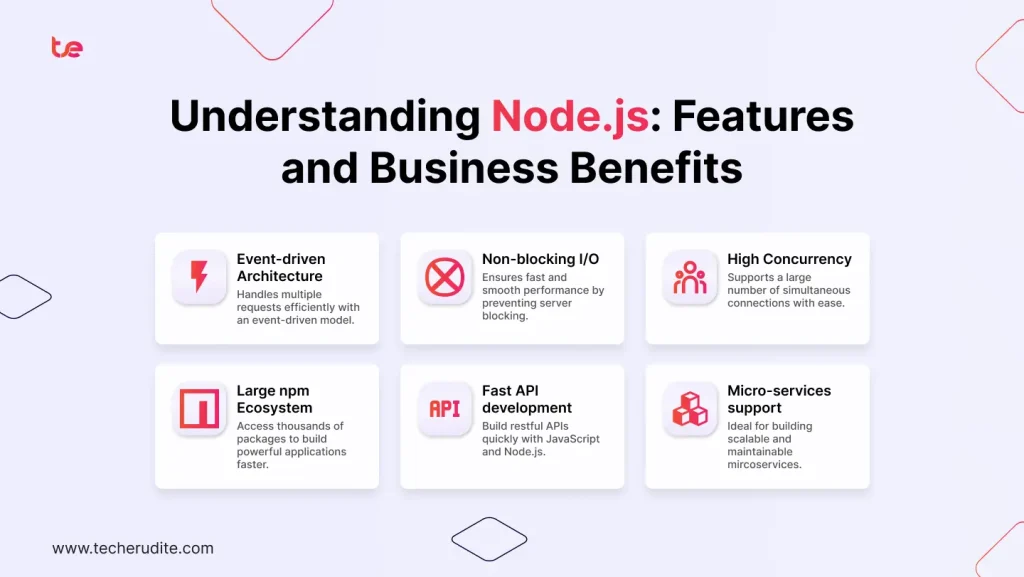
Node.js is an open-source, cross-platform environment that helps the developers create scalable and speedy back-end applications using JavaScript programming language. Node.js does not create a separate thread for each new request; rather, it uses an event-driven and non-blocking approach.
The companies which search for efficient applications would consider using an expert nodeJS development company to develop the backend of their application system.
Some of its key features include the following.
- Event-driven architecture
- Non-blocking I/O
- High concurrency
- Large npm package ecosystem
- Fast API development
- Microservices support
- Real-time communication
These features make Node.js an ideal platform for chat applications, live streaming applications, live dashboards, gaming applications, and collaboration applications The companies requiring specific expertise can also hire NodeJS developer team.
An expert node js development services can help in making applications that can sustain huge traffic volume without compromising on the speed of operation.
Laravel vs Node.js: Side-by-Side Feature Comparison
| Feature | Laravel | Node.js | Best Choice |
| Programming Language | Uses PHP with a structured framework approach | Uses JavaScript for both frontend and backend development | Depends on team expertise |
| Learning Curve | Easier due to built-in tools and clear documentation | Requires understanding of asynchronous programming | Laravel for beginners |
| Performance | Performs well for business applications and database-heavy systems | Excellent for high-concurrency and real-time applications | Depends on project type |
| Scalability | Supports large enterprise applications with proper architecture | Handles large-scale applications with multiple user requests | Both |
| Security | Includes built-in security features like authentication and validation | Requires proper package selection and security practices | Laravel |
| Development Speed | Faster with ready-to-use features | Faster for JavaScript-based projects and APIs | Laravel |
| APIs | Strong support for building business APIs | Excellent for REST APIs and microservices | Both |
| Community Support | Large PHP and Laravel community | Large global JavaScript community | Both |
| Enterprise Projects | Suitable for CRM, ERP, and business platforms | Suitable for distributed enterprise systems | Both |
| Real-Time Applications | Requires additional tools for real-time features | Built for real-time communication | Node.js |
Laravel and Node.js are both dependable, but every technology functions effectively in certain cases. Laravel is frequently chosen for business applications, whereas Node.js can be considered an excellent choice for platforms with real-time capabilities.
Need help choosing the right backend? Let’s build the perfect solution for your project.
Performance, Scalability & Development Experience
Performance
The Node.js platform is built on an event-based architecture, which means it is ideal for software that can handle multiple requests simultaneously. Examples of such software include chat applications, notification services, and multiplayer online games.
Laravel follows the request-response paradigm and works well in applications that have complicated business logics and database transactions. Caching, queuing, and database optimization functionalities are some of the ways that Laravel can boost performance in large-scale business applications.
Scalability
Both technologies support scalable applications.
Laravel is commonly used for:
- CRM systems
- ERP software
- SaaS platforms
- E-commerce websites
- Enterprise portals
Node.js is widely used for:
- Live chat applications
- Video streaming platforms
- Real-time dashboards
- IoT solutions
- API-first applications
Development Experience
Laravel has many built-in functions which can help save developers time when developing software. This framework has authentication, routing, validation, database handling, caching, and queuing functions which can be used right away without having to develop these functions from scratch.
Node.js makes development more flexible. The huge npm library contains packages for practically all the needs, and therefore Node.js can be considered one of the best solutions for developing custom applications and microservices. Developers who are already familiar with JavaScript can use it on both the client and server side.
Image Section 2
Laravel vs Node.js Performance Comparison
Security, Maintenance & Long-Term Support
Laravel
- Authentication: It offers built-in capabilities for logging in, registering, managing passwords, and controlling access for the users.
- Authorization: It allows permission control based on roles.
- Security Practices: It offers protection from common threats such as SQL injection, cross-site request forgery, and data validation.
- Framework Updates: It allows regular updating to ensure safety and compatibility.
- Long-Term Maintenance: It is easy to maintain due to its structured framework and built-in capabilities.
Node.js
- Authentication: Offers authentication via libraries and third-party packages.
- Authorization: Custom authorization is possible for developers according to application requirements.
- Security Best Practices: Needs proper management of dependencies, coding security, and updates of packages.
- Community Assistance: Has many developers who provide constant updates and security solutions.
Maintenance is easier with Laravel because it comes with all important features by default, whereas Node.js gives the option of flexibility with customization. The better choice depends on project requirements, team expertise, and long-term goals.
Which Backend Technology Is Best for Your Project?
It is important to have the correct backend technologies depending on what you need the application to do. However, both Laravel and Node.js offer great options for different business needs.
Choose Laravel If:
Laravel will be a great choice for your project if it needs structured development, security, and inbuilt features.
It is commonly used for:
- Enterprise software
- CRM and ERP systems
- SaaS platforms
- Business portals
- Secure web applications
- Content Management Systems (CMS)
- E-commerce websites
Companies that require quick deliveries and reliable support usually opt for Laravel website development services for developing scalable business applications.
Choose Node.js If:
Node.js would be more appropriate for applications where real-time interaction or handling of many users at once is required. Choosing a trustworthy node js development service will allow your application to scale along with your business.
It is commonly used for:
- Chat applications
- Live dashboards
- Video and music streaming platforms
- Gaming applications
- IoT solutions
- Real-time APIs
- High-concurrency systems
An experienced NodeJS Development Company will help you create an application that continues to function efficiently despite heavy traffic.
Laravel vs Node.js Decision Matrix
| Business Requirement | Recommended Technology | Reason |
| Enterprise Portal | Laravel | Built-in authentication, security, and structured architecture |
| CRM System | Laravel | Simplifies business logic and database management |
| SaaS Product | Laravel | Faster development with many built-in features |
| E-commerce Website | Laravel | Secure transactions and strong backend support |
| REST API | Both | Both provide excellent API development capabilities |
| Chat Application | Node.js | Handles real-time messaging efficiently |
| Streaming Platform | Node.js | Supports high concurrency and fast data processing |
| IoT Platform | Node.js | Processes multiple device connections smoothly |
| Live Analytics Dashboard | Node.js | Delivers real-time updates with low latency |
Both these technologies have the ability to develop modern web applications. Do not base your choice on the technology that is more popular; rather, consider your project needs, traffic, time frame, and scalability.
Final Verdict
Laravel vs Node.js does not have a definite winner because there is no one-size-fits-all solution. The right choice depends on selecting the technology that best aligns with your business goals and project requirements. Laravel is an excellent fit for enterprise software, SaaS platforms, CRM systems, and applications that benefit from built-in features and a structured development framework. On the other hand, Node.js is ideal for real-time applications, streaming platforms, APIs, and systems designed to handle thousands of concurrent users.
Before making your decision, evaluate your project’s functionality, scalability requirements, budget, and development timeline. If you’re unsure which backend technology is the right fit, the experienced development team at Techerudite can help you assess your business needs and recommend the most suitable solution for building a scalable, high-performance application.
