

The PHP language is still developing to make it relevant for existing websites as well as new applications. Based on the statistics from W3Techs, 70.6% of the websites that had a known server-side programming language were using PHP as of July 2026. This shows why changes to PHP still matter to developers and businesses.
Released on November 20, 2025, PHP 8.5 comes with a variety of new language elements and improvements for developers such as the pipe operator, URI extension, and better object cloning. This doesn’t mean that just upgrading will make all websites faster.
This guide highlights PHP 8.5 features, their influence on PHP web development, and considerations for organizations looking to adopt modern PHP development.
What Is PHP 8.5?
PHP 8.5 is the latest update to the PHP 8 version series. The official release date for this update was on November 20, 2025. The new features have been developed with the intent of improving the process of development.
Quick PHP 8.5 Facts
- Release: November 20, 2025
- Focus: Language improvements, new APIs, and developer productivity
- Upgrade: Compatibility testing is recommended
- Relevant for: PHP applications, APIs, frameworks, and web platforms
Upgrade versions are important since feature versions come with new functionalities, while maintenance and security versions mostly include bug fixes and security fixes. Version PHP 8.5 is actively supported, and it will receive security support until December 31, 2029.
Top PHP 8.5 Features You Should Know
Some of the major changes introduced by PHP 8.5 will simplify everyday coding tasks. These changes relate mainly to writing readable code, dealing with URLs, dealing with objects, and ensuring code security. Below is a list of PHP 8.5 new features.
1. Pipe Operator (|>)
The new PHP 8.5 pipe operator lets developers pass a value through multiple functions from left to right. This can make code easier to read compared with deeply nested function calls. For example:
</> PHP:
$slug = $title
|> trim(…)
|> strtolower(…);
This approach is useful when an application performs several transformations on the same value. Developers can follow the process from start to finish without moving through layers of nested functions. For projects with repeated data processing, the PHP pipe operator can make code simpler to understand and maintain.
2. New URI Extension
PHP 8.5 released a built-in URI extension for parsing, normalizing, and modifying URLs according to established web standards. This is useful for applications that regularly work with links, API endpoints, redirects, routing, and external services.
Instead of relying on different approaches for common URL tasks, developers can use dedicated URI APIs. This can make URL-related code more structured and easier to maintain. For businesses working on APIs or complex web platforms, this improvement can support cleaner PHP web development services and integrations.
3. clone() With Property Changes
PHP 8.5 makes it possible to update object properties while creating a clone. Developers can now pass an associative array to clone() to change selected properties in the new object.
This proves to be especially useful in situations where there are readonly classes or immutable-style programming applications. This approach helps to avoid repetition of code since it does not require one to make a separate object to change just one or two values. The result can be cleaner object handling and easier maintenance in larger applications.
4. #[\NoDiscard] Attribute
The new #[\NoDiscard] attribute helps developers catch cases where an important function return value is ignored. When a function uses this attribute and its result is not consumed, PHP can issue a warning.
This is useful for functions where ignoring the result could lead to unexpected behaviour. Developers can also intentionally ignore a value using a (void) cast. In larger applications, this feature can add an extra layer of code safety and make important API behaviour clearer during development and testing.
5. Closures and First-Class Callables in Constant Expressions
PHP 8.5 expands constant expressions by allowing static closures and first-class callables in places such as attribute parameters, property defaults, and constants.
This gives developers more flexibility when defining reusable application behaviour. It may prove valuable in systems where heavy use of configuration, attributes, or callbacks is a necessity. Although this may not affect the way every PHP application is coded, it offers additional possibilities for coders creating well-structured code.
6. New Functions and Developer Experience Improvements
Some of the other things that have been added by PHP 8.5 include various functions such as get_error_handler(), get_exception_handler(), Closure::getCurrent(), array_first(), and array_last(). It also adds new DOM methods and improvements to internationalization features.
For example, array_first() and array_last() functions allow users to have a more convenient way to get the first and last elements of an array, respectively. Though such minor modifications might appear simple, they may help developers cut down repetition and facilitate their job in some way. Thus, we can see how PHP 8.5 pays attention to both significant improvements and little things.
How PHP 8.5 Impacts Web Development
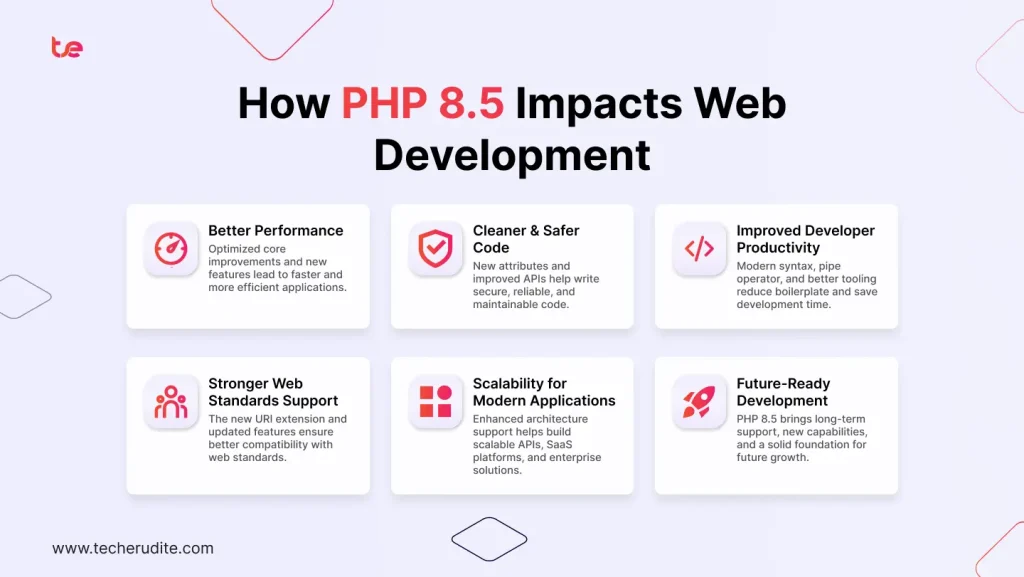
The PHP 8.5 version does not have the addition of new syntax alone. It may also have features that could impact how applications would be developed, maintained, and upgraded by the developers. The usefulness of such features would depend on their integration within the application.
Better Code Readability
The Pipe Operator may simplify code with multiple data manipulations. While with regular operations one would read function calls from inside out, with piped functions it is enough to read code from left to right. This feature is particularly convenient when processing user data, API data, or any other value using several functions.
Improved Developer Productivity
Many PHP 8.5 improvements will help reduce repetitive code. Some of these are new functions, improved object cloning, and support for constants as expressions. Cleaner syntax can also make code reviews and everyday development easier.
More Maintainable Applications
In large application development, small improvements can make a difference. More readable code and cleaner patterns will make applications easy to maintain and support. It will allow us to develop large and more complex applications while not complicating the process.
Better Foundation for Modern PHP Applications
PHP is continuously growing, developing new language and API capabilities, making PHP a technology that remains up-to-date for modern websites. Companies developing their applications can use the services of a PHP development company to find which version of PHP is required, along with the framework and architecture.
Planning to upgrade or modernize your PHP application?
PHP 8.5 vs PHP 8.4: What’s Changed?
Both updates have their strengths and work in different areas. Some of the improvements in PHP 8.4 include property hooks, asymmetric visibility, and improvements to the DOM extension. PHP 8.5 adds to this list of improvements with new language features, URI handling, and developer-focused improvements.
| Area | PHP 8.4 | PHP 8.5 |
| Major focus | Property hookslanguage improvements | URIpipe operatorlanguage improvements |
| URI capabilities | Existing approaches | New URI extension |
| Pipeline syntax | Traditional approaches | Pipe operator |
| Object cloning | Existing clone behaviour | Clone with property changes. |
| Developer tooling | Existing capabilities | Additional functions and improvements |
When it comes to companies deciding whether they should use PHP 8.5 vs PHP 8.4, this choice requires taking into account the issues of application compatibility, dependencies, development requirements, as well as the advantages that come with the new features.
Should You Upgrade to PHP 8.5?
PHP 8.5 upgrade may prove beneficial to an organization, but this upgrade must be based on the current state of the application, its dependencies, and future needs. It is an actively supported PHP release with security support through December 31, 2029.
W3Techs reported that 62.2% of PHP-powered websites were running PHP 8.x on July 26, 2026, compared with 29.6% on PHP 7.x and 8.1% on PHP 5.x.
Upgrade is worth considering if:
- Your application is running on an older supported PHP version.
- Your framework and Composer packages support PHP 8.5.
- You want to use its newer language features and APIs.
- You are already planning application modernization.
- Your staging environment and infrastructure have been tested successfully.
Don’t upgrade blindly if:
- Your application depends on outdated packages.
- Third-party libraries have compatibility problems.
- Your production environment has not been tested.
- Your code has minimal or no automation testing at all.
According to the official PHP migration guide, PHP 8.5 contains some incompatible changes, which means you should do your compatibility testing before going live.
PHP 8.5 and Laravel Development
PHP 8.5 is important in modern Laravel application development because the most recent Laravel environment is compatible with PHP 8.5. Laravel 13 works on PHP versions between 8.3 to 8.5. This means that developers can use PHP 8.5 while using Laravel.
Review must be done on the Composer packages, third-party libraries, application code, and server configuration prior to the upgrade. The Laravel upgrade documentation also points out other dependency and application-level upgrades.
When updating or upgrading Laravel applications, the following PHP development services can assist in analyzing the PHP version, framework compatibility, dependencies, and migration needs. Laravel development services providers can also analyze whether it is practical to upgrade the application based on its existing architecture and testing framework.
The point here should not be to upgrade just because PHP 8.5 is more recent. It should be done considering compatibility, security, project needs, and maintenance.
How PHP 8.5 Fits Into Modern Web Development
PHP 8.5 represents a trend towards better development environments. New capabilities and improved APIs make it possible for developers to write cleaner, more structured, and manageable code. This can be helpful for SaaS platforms, e-commerce websites, APIs, and business-oriented applications, which have to grow and develop further.
At the same time, current application systems are using intelligent automation, integration, and modern software development methods to increase productivity and improve user experience. PHP can be used along with these technologies within the framework of a larger application system. For more detailed information on this change, see AI in Web Development: Driving Automation, Intelligence, and Scalable Productivity.
PHP 8.5 Migration Checklist
Use the checklist below before moving your application to production.
- ☐ Check your latest PHP version and identify the upgrade path.
- ☐ Review PHP 8.5 backward-incompatible changes that could affect existing code.
- ☐ Audit Composer dependencies and confirm package compatibility.
- ☐ Check framework compatibility before making changes.
- ☐ Test the application in a staging environment that matches production.
- ☐ Run automated tests and fix compatibility issues.
- ☐ Review deprecated functionality used by the application.
- ☐ Monitor performance after upgrading.
- ☐ Deploy gradually to reduce production risks.
- ☐ Keep a rollback plan ready in case unexpected issues occur.
The official PHP migration guide also recommends testing for incompatibilities before switching versions in production.
Who Should Consider Upgrading to PHP 8.5?
PHP 8.5 may be worth considering for businesses and developers requiring more modern capabilities of the language, improved development tools, and a supported PHP version. PHP 8.5 may be applicable in the following.
- Businesses running older PHP versions that need a supported and maintainable environment.
- Teams modernizing existing applications and planning broader code or infrastructure improvements.
- New projects that want to start with a current PHP release and its latest capabilities.
- Laravel and API development teams developing applications using Laravel or API which work with PHP 8.5.
- Firms migrating from old systems, in which case an upgrade will form part of a bigger project.
But the process of upgrading should still be based on compatibility, dependency review, testing of the upgraded solution, and having a rollback strategy. It all depends on the existing condition of the application and business requirements.
Final Thoughts: Is PHP 8.5 Worth Considering?
The addition of PHP 8.5 includes some good additions in the form of useful language constructs, APIs, and some other developments for the developers, proving that PHP is still growing for the modern world. PHP 8.5.8 was released on July 2, 2026, as a security release.
Not all projects need to immediately upgrade. Companies need to consider their PHP version, dependencies, framework compatibility, codebase, and the testing process when considering moving. This is particularly true for legacy software where compatibility may be an issue.
When it comes to developing PHP apps, Laravel projects, upgrading legacy PHP solutions, creating APIs, or web platforms for enterprises, professional developers will guide you through the process. TechErudite can help businesses design and develop web apps that meet their technical and business needs.
