
Enterprise websites are no longer simple pages. They require serving thousands of users and connecting with several systems. This is where Next.js for Enterprise Web Applications is needed.
Next.js usage was recorded by 59% of participants in the 2025 State of JavaScript survey, which proves its popularity within modern web development teams.
As companies shift towards using SaaS solutions, customer portals, eCommerce solutions, and in-house applications, the traditional enterprise software development methodologies are becoming more difficult to maintain. Next.js offers features like flexible rendering, routing, server components, and performance that enable teams to create modern web applications.
But is Next.js suitable for enterprise applications? In this guide, we will discuss the benefits of Next.js for enterprise web development in terms of performance, scalability, security, development speed, maintenance, and more.
What Makes an Enterprise Web Application Different?
An enterprise web application is designed to meet the needs of an organisation’s day-to-day activities. Unlike a simple website, it can handle large amounts of data, many users, and multiple business processes at one time.
An ideal enterprise application will have the following features.
- Scalability: Capable of handling more users and more data.
- Security: Protects customer data, employee data, and company data.
- Performance: Provides quick response times.
- Multiple types of users: Gives different types of users access to the application.
- Third-party Integrations: Connects to payment systems, CRMs, APIs, etc.
- Long-term maintainability: Helps with future updates.
It is crucial to choose the appropriate framework since it affects development time, application efficiency, security, scalability, and maintenance cost.
Why Next.js Is Becoming the Preferred Framework for Enterprise Development
React is a framework for building web applications. It supports several rendering techniques, routing, server components, and built-in performance optimization techniques.
These benefits can be useful for business organisations to develop applications that are quick and easy to manage. Server-side rendering and static generation may also enable businesses to optimize their applications for search engines.
Next.js can improve developer efficiency through various development activities that the framework performs. The framework’s flexibility allows it to be used for SaaS platforms, enterprise portals, eCommerce sites, and large-scale customer-facing applications.
This is the reason why many businesses today look at Next.js Development for enterprise web application development projects.
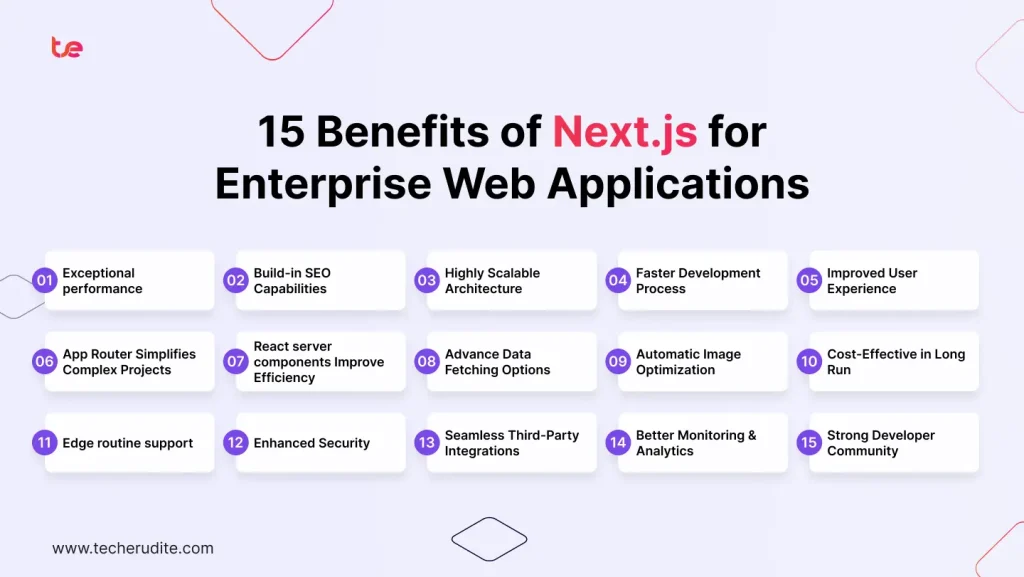
15 Benefits of Next.js for Enterprise Web Applications
1. Exceptional Performance
Next.js performance is one of its most important strengths. Technologies like server-side rendering, caching, and optimised page loading will allow for efficient page loading. This feature is beneficial for portals and eCommerce websites that have lots of visitors.
2. Built-in SEO Capabilities
Next.js supports server-side rendering and metadata generation and helps search engines understand website content. Next.js can be used in any enterprise website where search engine traffic is important, for example, e-commerce sites, service platforms, or portals.
3. Highly Scalable Architecture
Next.js scalability makes it suitable for applications that require scalability as the business expands. Developers have the ability to build modular apps and develop additional features depending on their needs. This is good for SaaS applications, dashboards, and enterprise portal applications.
4. Faster Development Process
These include the capabilities for routing, rendering, optimising images, and other helpful functionalities built into the framework. This allows programmers to save time configuring common functionalities and work on meeting the needs of the business.
5. Improved User Experience
Next.js provides several features that help optimise content delivery. This feature helps when dealing with customer portals, e-commerce sites, and other platforms that require instant responses from users.
6. App Router Simplifies Complex Projects
The App Router helps to structure pages, layouts, and functionalities within an application. This makes it easier to manage complex projects by organising all related functionalities. This is particularly beneficial for enterprise applications that consist of many sections and processes.
7. React Server Components Improve Efficiency
Some React components can run on the server using React Server Components rather than transferring all code of these components to the browser. This may decrease client-side processing and help the application use its resources more efficiently since many pages have a lot of information.
8. Enhanced Enterprise Security
Features are available in Next.js to create applications that are secure. However, the security of an application is dependent on how it is created. Developers can use the framework features along with authentication, authorisation, and API management for enterprise applications.
Looking to Build a High-Performance Enterprise Application?
Explore our Next.js software development services and web development services to build fast, secure, and scalable enterprise applications based on your business requirements.
9. Easy API & Third-Party Integration
The enterprise application may require connectivity with payment gateways, CRMs, analytics tools, database systems, and external APIs. Next.js is compatible with all such services, allowing business enterprises to integrate various systems in one application.
10. Flexible Deployment Options
The Next.js apps can also be deployed through various types of hosting depending on the requirements of the projects. The developers can opt for hosting solutions that will suit the traffic, infrastructure, and other requirements.
11. Lower Long-Term Maintenance Costs
The structure of a good Next.js application makes it easier to maintain as the project gets bigger. Components that are reusable, proper routing, and development processes make it possible for developers to update an app without modifying other unrelated parts.
12. Enterprise-Friendly Ecosystem
Next.js is compatible with the larger ecosystem of React and JavaScript, which gives companies access to a number of tools and libraries. This makes it easier for organisations to hire developers and integrate services based on their needs.
13. Easy Headless CMS Integration
Next.js can integrate with headless CMSs to ensure that content management is decoupled from the frontend. The process is particularly helpful for businesses with content management requirements on websites and portals via various digital channels while still controlling the UI.
14. Future-Ready Architecture
There is a need for these applications to adapt to changes in the business environment. Next.js has a capacity for varying renderings, reusable components, and flexible application architectures. Developers will be able to add new features without rebuilding the whole application.
15. Faster Time-to-Market
Next.js offers various benefits that help reduce the number of steps involved during the development process. Given an appropriate design and an expert team, companies will be able to progress from conception to launch quickly while also remaining performance-, security-, and user-focused.
Why Next.js Outperforms Traditional React for Enterprise Projects
React and Next.js are similar in some ways, but there is a difference in terms of built-in capabilities that they offer. The React framework primarily takes care of the user interface part, whereas Next.js comes with capabilities like routing, rendering, optimisation, and even full-stack capabilities. This can help save the effort of setting up things for enterprise-level teams.
| Feature | Next.js | Traditional React |
| SEO | Built-in rendering and metadata support | Requires additional setup |
| Performance | Built-in optimisation features | More manual optimisation |
| Routing | Built-in App Router | Usually needs React Router |
| Image Optimisation | Built-in Image component | Additional setup may be needed |
| Scalability | Supports large application architectures | Depends on project architecture |
| Rendering | SSR, SSG, and other options | Mainly client-side by default |
| Developer Experience | Full framework with built-in tools | Flexible UI library |
| Enterprise Readiness | Strong choice for large applications | Depends on implementation |
When Should You Choose Next.js for Enterprise Applications?
Next.js for Enterprise Web Applications is a good option to consider if your company requires a quick, efficient, and scalable web platform.
This can be used across various industries and applications, such as the following.
- Enterprise SaaS platforms: Develop subscription-based solutions, including dashboards, user accounts and various access levels.
- Healthcare portals: Create secure platforms for appointments, patient data and healthcare services.
- Financial applications: Develop customer portals, reporting systems, and financial dashboards.
- Enterprise dashboards: Integrate business data and reporting into one solution.
- Logistics platforms: Offer solutions to track shipments, manage fleets, and update orders.
- eCommerce websites: Create a fast eCommerce store with a product catalogue and customer accounts.
- Education platforms: Create online learning solutions and portals for students.
- Manufacturing solutions: Manage production data, inventory, suppliers, and internal processes.
Choice depends on the application’s features, its users, integrations, security requirements, and future business objectives.
Wrapping It Up
There are many advantages provided by Next.js for enterprise web applications for modern enterprises. Some of them include good performance, rendering options, scalability, SEO functionality, fast development, and easy integration with different solutions. This framework can be used for SaaS platforms, eCommerce sites, dashboards, health care portals, and other complex web applications.
However, choosing the right framework ultimately depends on your project requirements, business objectives, budget, and development team’s expertise. With the right strategy and implementation, Next.js can be a future-proof choice for modern enterprises. If you are planning to build or modernize an enterprise application, partnering with an experienced team such as TechErudite can help you leverage Next.js development services to create a scalable, high-performing, and business-focused web solution.
