
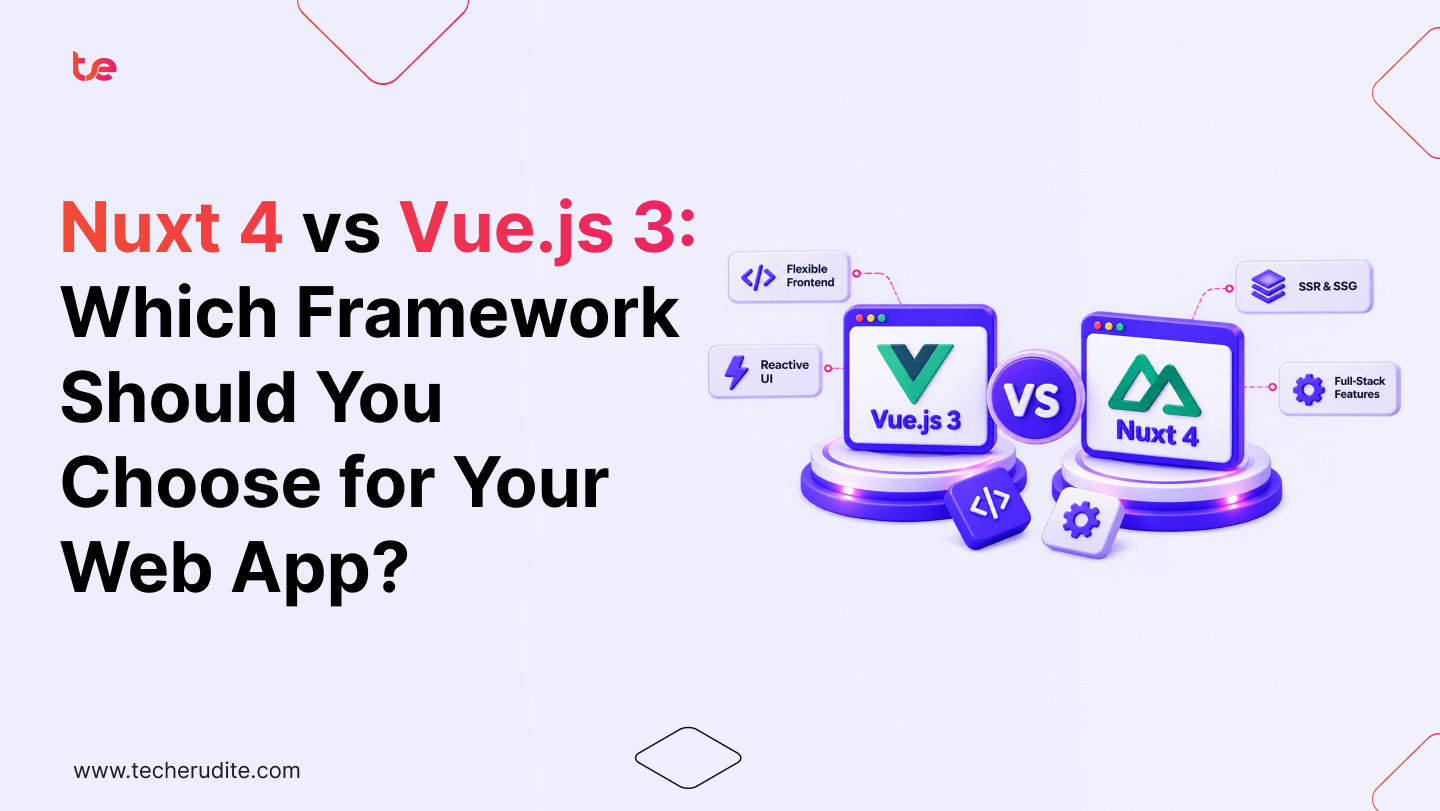
Vue.js 3 is a framework that helps build interfaces, whereas Nuxt 4 is a framework that has many new features such as file routing, server-side rendering, an API for the server and so forth. The proper one will depend on SEO, rendering, backend and other aspects.
Vue is popular, with over 11 million weekly downloads of the Vue package via npm in 2026.
In Nuxt 4, Vue 3 has been used rather than competing with the same architectural structure. In the case of Vue js development, Vue is flexible in the use of front-end applications, whereas Nuxt provides more architecture for the applications with SSR and server functions.
Nuxt 4 vs Vue.js 3: What’s the Difference?
Vue.js 3: Frontend Framework
The Vue.js 3 framework is one that is built to work with reactive UI interfaces by making use of reusable components. Routing and server-side rendering are some features that can be achieved through the framework.
Nuxt 4: Vue-Based Application Framework
Nuxt 4 uses Vue 3 and includes application capabilities including route configuration based on files, SSR, static generation, data fetching, and server-side API functionality via Nitro. It is an integrated solution for building websites and full-stack applications.
Key Difference
The comparison between Nuxt 4 and Vue 3 does not involve two frameworks that have identical functions. Nuxt is a framework that builds on Vue 3 but adds conventions and rendering to it. Vue 3 is highly flexible, while Nuxt is highly structured.
| Feature | Vue 3 | Nuxt 4 |
| UI | Yes | Yes |
| Routing | Vue Router | File-based |
| SSR | Ecosystem | Built in |
| SSG | Tooling | Built in |
| Server APIs | External | Nitro |
| Full-stack | Separate | Integrated |
What Is Vue.js 3?
Vue.js 3 is a front-end framework built around components to develop user interfaces. Vue uses a reactive framework that updates the user interface based on changes in the application data.
Key Features
- Composition API: Breaks down the logic of components into functions that can be reused and makes large-scale applications easy to manage.
- Single File Components: Merges template, logic, and styling into one .vue file.
- TypeScript support: Helps developers to develop reliable and maintainable applications.
- Vite-based development: Speeds up development and build processes.
- Vue Router: Manages navigation and routing in single-page applications.
- Pinia: State management for shared application data.
Where Vue 3 Fits Best
Vue 3 is suitable for SPAs, dashboards, admin panels, enterprise business applications, and customized frontend applications. Vue js development services could be useful in cases where the frontend requires flexibility and the backend runs independently.
What Is Nuxt 4?
Nuxt 4 is a framework developed using Vue 3 for websites and web applications. It adds an integrated structure around Vue, reducing the need to configure features separately.
Key Capabilities
- File-based routing: Routes are automatically generated based on the folder structure of the project.
- SSR: Pages render on the server as the default mode for initial rendering and SEO-friendly rendering.
- SSG/prerendering: Generates selected pages ahead of time for static delivery.
- Hybrid rendering: Supports different rendering strategies across routes.
- Auto-imports: Simplifies access to components and composables.
- Data fetching: Provides utilities for application and server data.
- TypeScript: Supports typed development.
- Nitro: Powers server functionality, API routes, and deployment options.
- Code splitting: Loads application code efficiently.
Static generation and hybrid rendering are two approaches that Nuxt supports. With regard to Nuxt 4, it is important in the year 2026 since Nuxt 3 went into end-of-life on July 31, 2026.
Nuxt 4 vs Vue.js 3 for Performance and SEO
Nuxt 4 can make SEO and performance architecture easier because several capabilities are integrated into the framework. Vue.js 3 is also capable of working for SEO-oriented apps, although the necessary approach to rendering and optimizing them will depend on the application architecture.
SEO
Nuxt 4 includes server-side rendering (SSR), and this enables it to provide rendered HTML that could be used by both browsers and search engine bots. This ensures that the information is accessible without depending on JavaScript alone.
It also supports the following.
- Prerendering: Pre-render HTML for specific routes.
- Metadata: Control SEO metadata like titles and descriptions.
- Structured content: Structure page content as crawlable HTML.
- Hybrid rendering: Apply various rendering methods to various routes.
Vue.js 3 can also produce similar SEO results with proper tools and frameworks.
Performance
Nuxt 4 also provides features that can support performance, including the following.
- Code splitting
- Server rendering
- Caching strategies
- Hybrid rendering
- Bundle optimization
These features do not guarantee better rankings or faster websites. Conclusions are dependent on implementation, content, hosting, and application architecture.
When Should You Choose Vue.js 3?
Select Vue.js 3 if your project requires mainly the frontend to be versatile, and the backend is either available or is to be created independently. This choice is recommended if you require architectural flexibility, your project is an SPA, or SEO is not one of your primary requirements.
Vue 3 is an excellent choice for projects that have teams working within its ecosystem and would like to develop custom-made interfaces easily. Examples include SaaS dashboards, admin panels, internal systems, client portals, and dynamic web applications.
Vue.js development services can help companies build custom frontend architecture that uses already available APIs, authentication systems, databases, and backend services as per their project requirements.
When Should You Choose Nuxt 4?
Select Nuxt 4 if your web app requires more than just frontend technology and needs features like rendering, routing, and server functionalities.
Nuxt 4 is a strong choice when:
- SEO is important: SSR and prerendering will help to make SEO-friendly rendering simpler to achieve.
- You need SSR: Send the rendered HTML from the server and not from the client.
- You need SSG: Pre-render the pages to serve as static content.
- You want file-based routing: Create routes through your project structure with less manual configuration.
- You need frontend and server capabilities: Nitro supports server routes, middleware, and API functionality.
- You want hybrid rendering: Apply different rendering strategies to different routes.
- You are building content-heavy websites: Useful for sites where crawlable, rendered content matters.
- You want an integrated architecture: A Nuxt js development company can use Nuxt’s built-in capabilities for applications such as e-commerce stores, corporate websites, SaaS marketing sites, content platforms, marketplaces, and SEO-driven web applications.
Nuxt 4 vs Vue.js 3: Which Is Better for Different Projects?
It all depends on the needs of your web application. While Nuxt 4 is good for applications that will take advantage of integrated rendering and routing, Vue 3 works best for flexible frontend applications.
| Project Type | Recommended |
| SEO-focused website | Nuxt 4 |
| E-commerce website | Nuxt 4 |
| Content-heavy website | Nuxt 4 |
| Marketing website | Nuxt 4 |
| Internal dashboard | Vue 3 |
| Admin panel | Vue 3 |
| Existing separate backend | Vue 3 |
| Full-stack web application | Nuxt 4 |
| Highly customized SPA | Vue 3 |
Such suggestions are general. It is up to your architecture, the skills of your team members, available infrastructure, and the specific needs of your project to make the right choice. The project that seems suitable for one framework might be suitable for another due to its technical limitations and objectives.
How to Choose Between Nuxt 4 and Vue.js 3
Choose the framework by asking five questions:
- Does the website require strong SEO?
- Do you need SSR/prerendering?
- Do you need any server capabilities?
- Is the backend already available?
- Does your team prefer flexibility or convention?
If you are not sure about which architecture will be suitable for your project, a Vue.js development team is ready to analyze your SEO, performance, backend, and scalability needs.
Considering planning a Vue.js or Nuxt application? Consult with our Vue.js development experts to select the perfect framework and development approach for your application.
Wrapping It Up
Nuxt 4 and Vue.js 3 serve different application needs rather than being direct alternatives. Vue.js 3 provides a flexible foundation for frontend applications, SPAs, dashboards, and projects with a separate backend, while Nuxt 4 extends Vue 3 with built-in routing, server-side rendering (SSR), prerendering, hybrid rendering, and server capabilities. If SEO, server rendering, content delivery, or full-stack architecture is important, Nuxt 4 can simplify the development approach. For highly customized frontend applications where flexibility is the priority, Vue.js 3 can be a suitable choice.
At Techerudite, our Vue.js development experts can help businesses evaluate their SEO, architecture, performance, backend, and scalability requirements to choose the right Vue.js or Nuxt 4 development approach for their web application.
FAQs

Chief Technology Officer (CTO)